Road safety throughout wet weather
Being ready for general wet weather

Be Safe in Rainy Roads: Driving in wet weather are often terribly dangerous. you ought to prepare and regularly maintain your vehicle to form positive you may continually be as safe as doable once driving in wet conditions.
To get your vehicle prepared for driving in wet weather build sure:
- You have smart tyre tread (at least one.5mm deep across the full tyre width)
- All of your vehicle’s lights work well.
- Your screen and lights are clean.
- Learn additional concerning maintaining your automobile.
Driving safely generally wet weather
We advocate you explore weather forecasts and road condition updates, and set up your drive before heading out on long visits. this can assist you to avoid driving in and around unsafe conditions. However, our weather will amendment dramatically, even inside the house of a brief drive. after you end up in sudden wet weather (such as a fast moving storm), follow these safety tips.
In wet conditions:
- Drive slowly—to avoid aquaplaning and skidding
- Drive along with your lights on ray of light (it is less complicated to check with ray of light in fog)
- Use your air conditioning or warmer to stay your screen further from condensation
- Double the gap between you and also the automobile ahead
- Avoid breaking suddenly or fast or turning quickly—to cut back your possibilities of skidding
- Do not drive on unsealed roads
- Use road line markings to stay in the middle of your lane—in wet weather, it is more important than ever to stay
- In the correct position on the road
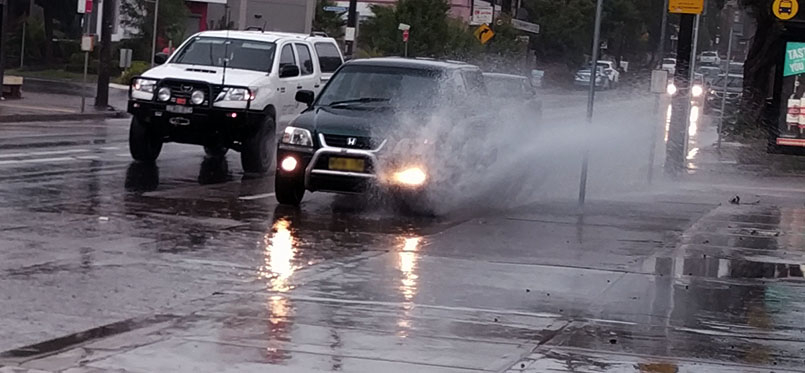
- Do not drive on roads covered with water (even partially covered)
- Watch out for landslides—heavy rain can cause layers of rock and soil to move
- Stay away from the stagnant water by the side of the road (it can be very bad for your health).
Drive slowly
When driving in wet weather, you should always remember that the signed speed limit is the maximum safe speed in ideal driving conditions, so you may need to drive slower in wet weather.
Aquaplaning
Aquaplaning is where there is a build-up of water between the road surface and your tyres, causing them to lose contact with the road surface completely. If this happens, you may lose control of your vehicle.
To reduce your chances of aquaplaning in wet weather, slow down and do not use cruise control.
Skidding
If some of your vehicle’s tyres slip, but you still have some traction on the road, you are skidding. If your vehicle starts skidding, it may become difficult to control. Wet surfaces can increase your risk of skidding. When you are driving in the wet, reduce your speed and allow all of your tyres to grip to the road at all times.
To prevent skidding:
-
Accelerate smoothly
-
Brake smoothly
-
Corner smoothly.
-
Double the distance between you and the car in front
If you drive too close to the vehicle in front of you, you are likely to crash if they brake suddenly. Keep far enough back so that, if they do something you are not expecting, you can still stop in time.
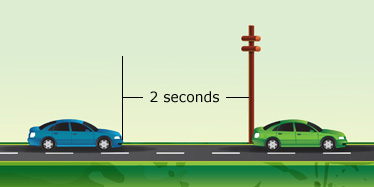
: Image of 2 cars on the road, with a power pole. The image indicates that there should be 2 seconds between the rear of the first car passing the pole and the front of the second car passing the pole.
In good weather, make sure there is at least 2 seconds between you and the vehicle in front.
Cars
If you are driving a standard car, you should drive at least 2 seconds behind the vehicle in front of you. In wet weather, you need to double your stopping time—so you will need to travel at least 4 seconds behind the vehicle in front.
Heavy vehicles, trailers, and caravans
If you are driving a heavy vehicle, you should drive at least 4 seconds behind the vehicle in front of you. In wet weather, you need to double your stopping time to at least 8 seconds. If you are driving a vehicle with a trailer or caravan attached, you should allow at least 2 seconds for your car and 1 second for each 3m of your trailer/caravan in normal conditions. In wet weather, you will need to allow at least 4 seconds for your car and 2 seconds for each 3m of your trailer/caravan.
How to judge the distance
To work out how many seconds you are behind the vehicle in front of you:
Pick a mark on the road, or an object close to the left side of the road (such as a power pole).
When the back the vehicle in front of you passes the mark or object, count ‘one-thousand-one, one-thousand-two, one-thousand-three, one-thousand-four’. This takes about 4 seconds.
If the front of your vehicle reaches the mark or object before you finish counting, you are too close and need to drop back.
Driving safely in floods
Floods can occur almost anywhere in Queensland and can rise over days, or in minutes in a flash flood.
Do not travel in flooded areas unless it is essential. If you must drive in or near a flooded area, try to view updates on road conditions and closures before heading out—so that you can take the safest possible route. But importantly, never attempt to drive across a flooded road.
Flood road signs
To keep you safe and protect our roads, we must carefully manage roads that have been flooded.
To do this, we may:
close roads
put load restrictions on and around flooded roads
put traffic controls at and around flooded roads.
If you need to drive in an area that has been flooded, signs will warn you of the roads that are unsafe to use. Always follow the directions of flood road signs and drive with extreme caution. Learn the flood barriers and signs.
Flood safety tips
If you must drive in a flooded area:
never drive on a road or bridge covered with water—floodwaters can be fast moving and contain debris
always take extra care when driving on a road or bridge that has been recently flooded—as it may be damaged or still drying out.
Road Safety Products
2 . COLUMN GUARDS
3 . WHEEL STOPPER
4 . SPRING POST
5 . TRAFFIC CONE
6 . ROAD STUDS
7 . CONVEX MIRROR
8 . QUE MANAGER
9 . BATONS
10 . ROAD BARRIER